
- Home /
- CAD/CAM /
- CHROME COBALT BLANKS /
- Chrome Cobalt
Categories
- 3D PRINTING RESIN
- ABRASIVE MATERIAL
- ACRYLICS
- ADHESIVES, PRIMERS & CEMENT
- ALLOYS
- ARTICULATING
- ATTACHMENT, IMPLANTS & MAGNETS
- BOOKS
- BOXES & STORAGE
- BURNOUT & IMPRESSION POSTS
- Brushes & Mixing Trays
- CAD/CAM
- COMPOSITES
- CROWN & BRIDGE
-
DENTURE TEETH
- ACCESSORIES
- BREDENT VISIO LIGN SYSTEMS
- CLEANING
- KAIFENG SHADES A1 - A4
- KAIFENG SHADES B1 - B4
- KAIFENG SHADES C1 - C4
- KAIFENG SHADES D2 - D4
- MAIST SHADES A0 - A00
- MAIST SHADES A1 - A4
- MAIST SHADES B1 - B4
- MAIST SHADES BL1 - BL2
- MAIST SHADES C1 - C4
- MAIST SHADES D2 - D4
- PALA MONDIAL SHADES A1 - A4
- PALA MONDIAL SHADES B1 - B4
- PALA MONDIAL SHADES BLEACH
- PALA MONDIAL SHADES C1 - C4
- PALA MONDIAL SHADES D2 - D4
- SHADE & MOULD GUIDES
- TOOTH CABINETS
-
EQUIPMENT
- ACCESSORIES & SPARE PARTS
- AIR BLOWING
- BOIL OUT
- BURNERS & TORCHES
- CASTING
- CLEANING
- COMPRESSORS
- DEFLASKING
- DUPLICATION
- DUST EXTRACTION
- FUME EXTRACTION
- GRINDER
- HANDPIECES & MICROMOTORS
- INDUCTION HEATERS
- INJECTION SYSTEMS
- LATHES
- LIGHT CURING
- LIGHTING
- MAGNIFICATION
- MILLING
- MIXING
- MODEL & ARCH TRIMMING
- PIN DRILLING
- PLASTER TRAPPING
- POLISHING
- PREHEATING FURNACES
- PRESSURE POLYMER UNITS
- SAND BLASTERS
- SHADE TAKING
- SINTER FURNACES
- SPARE PARTS
- STEAM CLEANER
- TURBINES
- VACUUM FORMER
- VIBRATORS
- WAXING
- IMPRESSION MATERIALS & TRAYS
- INFECTION CONTROL
-
INSTRUMENTS
- CALIPERS
- CERAMIC BRUSHES
- CERAMIC INSTRUMENTS
- COMPOSITE INSTRUMENTS
- HAMMERS
- HEMOSTATS & TWEEZERS
- INSTRUMENT KITS
- MARGIN MARKERS
- MEASURING CUPS
- MIXING BOWLS
- MIXING TIPS & GUNS
- MIXING TRAY ACCESSORIES
- MIXING TRAYS
- MPF DRIVERS
- OTHER BRUSHES
- PLASTER KNIVES
- PLIERS
- SAWS & BLADES
- SCALPELS & SCALPEL BLADES
- SCISSORS & CUTTERS
- SMILE LINE DRIVERS
- SMILE LINE HANDLES
- SMILE LINE VENEER ME
- SPATULAS
- STANDS
- SURVEYING
- TWEEZERS
- WAX INSTRUMENTS
- WORKING MATS
- INVESTING
- MIYO
- MODEL MAKING
- PLASTER, STONE & PUTTY
- PLATING & TINTING
- POLISHING MATERIAL
-
PORCELAIN & STAINS
- ACCESSORIES
- BONDS
- GC INITIAL INCISIO/INVIVO
- GC INITIAL IQ
- GC INITIAL IQ ONE BODY CONCEPT
- GC INITIAL LF
- GC INITIAL LISI
- GC INITIAL MC
- GC INITIAL TI
- GC INITIAL ZRFS
- NORITAKE CZR
- NORITAKE EX3
- NORITAKE EX3 ADDMATE
- NORITAKE EX3 EXTERNAL STAINS
- NORITAKE EX3 INTERNAL STAINS
- NORITAKE EX3 LUSTER
- NORITAKE EX3 PASTE OPAQUES
- NORITAKE EX3 VALUE SHADE
- NORITAKE GUIDES
- NORITAKE LIQUIDS
- OTHER STAINS
- UNIVERSAL MIXING LIQUID
- PREHEATING, CASTING & SOLDER
- PREPARATION & DUPLICATION
- PRESSING
- RELINING
-
ROTARY
- ACCESSORIES
- ACRYLIC
- ARBOR BANDS & ACCESSORIES
- BREDENT DIAGEN TURBO GRINDERS
- BRUSHES FOR HANDPIECE
- BRUSHES FOR LATHE
- BUFFS & MOPS FOR HANDPIECE
- BUFFS & MOPS FOR LATHE
- BUR STANDS
- BURS FOR SILICONE
- DIAMOND DISCS
- DIAMOND FG
- DIAMOND GRINDERS
- DIAMOND HP
- DIAMOND SINTERED FG
- DIAMOND SINTERED HP
- DISCS & WHEELS
- DRILLS
- FELT POLISHERS
- GRINDERS FOR ACRYLIC
- MANDRELS
- MILLING TECHNIQUE BURS
- POLISHING
- PRE-SINTERED ZIRCONIA
- SCOTCH-BRITE
- SETS
- STANDS
- STEEL
- STONES
- TITANIUM
- TUNGSTEN CARBIDE
- STAINS - LIGHT CURING
- STUDENTS
- THERMOFORMING
-
WAXING
- ACCESSORIES & LIQUIDS
- ADHESIVE COATED
- BEADS & CRYSTALS
- BITE BLOCKS
- BLOCKING
- CASTING WAX
- CERVICAL
- DIAGNOSTIC WAX
- DIPPING WAX
- INLAY WAX
- MILLING WAX
- MODELLING WAX
- OTHER WAX
- PERIPHERY WAX
- PREPARATION WAX
- SCAN WAX
- SET UP WAX
- STICKY WAX
- WAX FOR DENTURES
- WAX PATTERNS
- WAX PROFILES
- WAX RETENTIONS
- WAX SPRUES
- WAX WIRE
- WIRES, MESH, CLASPS & BARS
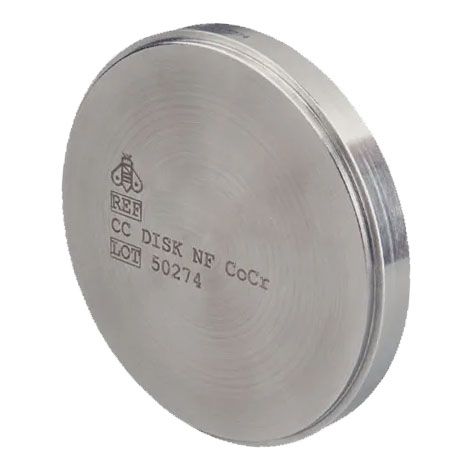
Chrome Cobalt
Description
CC DISK NF CoCr - CoCr based disc for CAD/CAM system, free of nickel and beryllium which fulfils the requirement of the standard EN ISO 22674 for non-precious alloys and ISO 9693-1 for alloys intended for porcelain fused to metal restorations.
It is made of biocompatible alloy, which is easy to polish, has small amount of oxides and is therefore extremely suitable for porcelain. Ideal coefficient of thermal expansion allows usage of wide range of different ceramics.
You can use all types of porcelain you use for the classical veneering method on casted constructions, such as crowns and bridges, bars, Toronto bridges and other supra-structures.
The Vickers hardness 281 (HV10) value leads to good milling and drilling behaviour and gives a perfectly polished surface. Only few oxides are formed during ceramic firing.
Composition (m %):
Co (Cobalt): 63.0
Cr (Chromium): 24.0
W (Tungsten) : 8.0
Mo (Molybdenum): 3.0
Si (Silicon): 1.0
Nb (Niobium): < 1.0
Technical Data:
Type: 4
Density: 8.3 g/cm3
Coefficient of Thermal Expansion:
25–500 °C: 14.7 x 10^-6 K^-1
20–600 °C: 15.0 x 10^-6 K^-1
Vickers Hardness (HV10): 281
Yield Stress (Rp0.2): 478 MPa
Tensile Strength (Rm): 581.5 MPa
Modulus of Elasticity (E): ≈ 225.0 GPa
Elongation after Fracture (A15mm): 10.4 %
Indications:
Used for multiple-unit fixed dental prostheses for ceramic firing, including appliances with thin sections subject to high forces (e.g., removable partial dentures, clasps, thin veneered single crowns, full-arch prostheses, bars, attachments, implant-retained superstructures).
Contraindications:
Not suitable for patients with known allergies to alloy components.
Intended Users:
Dental professionals (dental technicians).
Patient Selection Criteria:
Totally or partially edentulous patients.
Ceramic Firing:
Use ceramics suitable for porcelain-to-metal restorations with appropriate thermal expansion coefficients (e.g., VITA, Ivoclar, Ducera).